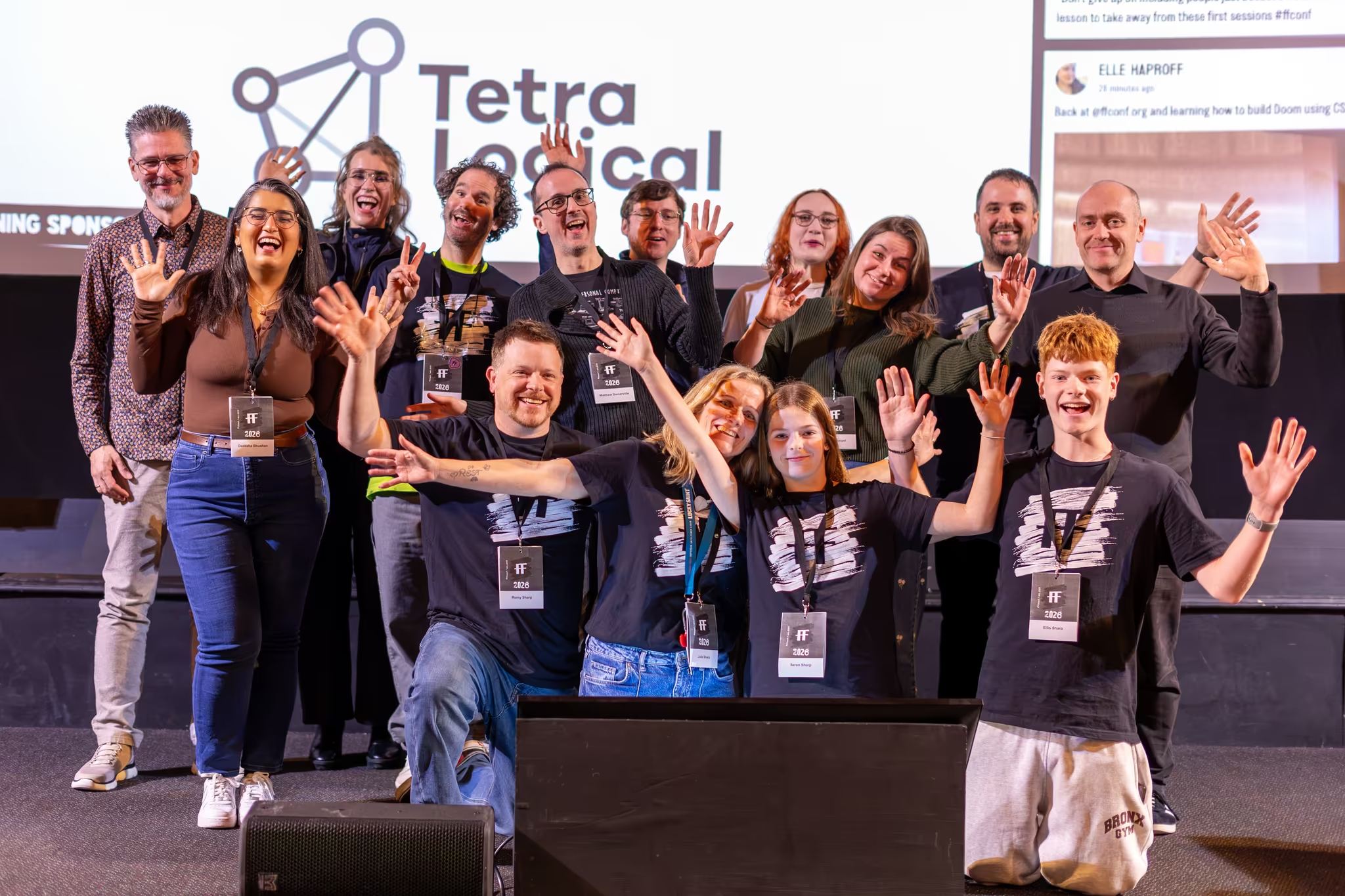
It's been two weeks since the latest FFConf and I've been busy to the point that I've not had a huge amount of time to let it all sink in.
At the after-party often people ask are we glad now it's all done, but there's always the last 5% to be done after the event - and it's all critical. Admittedly that split is more like 1:5 between me and Julie - Julie has some of the last payments to make (speakers), sorting out dates for 2027 and a number of other bits that I'm hidden from.
Due to timing, it was also Julie's birthday on Wednesday and I returned to work on Thursday, so I can see why I've not had a huge amount of time to reflect.
That all said, let's have a go.
The day itself split fairly clearly down the middle with the start of the day being focused around practical (even though Niels, who opened the event, was showing DOOM in CSS and on an oscilloscope).
The second half of the day was about how we think of the web, our work and the greater ideas around what we do. That's a vague description, sorry.
The curation and ordering of the talks is always important. It's one of my primary tasks for the event to attempt to create connections and a cohesion that our audience can connect with.
The first talk, the impractical but playful talk by Niels on DOOM with CSS was followed by Helen's (first time) talk on adding accessibility to canvas based experiences.
The mid-morning started with Matthew giving some history but also practical comparisons of how his trainline.org.uk compares to a larger equivalent site such as nationalrail.co.uk (Matthew's website is one I've known of and used for what seems like decades).
He was able to show filmstrip performance runs showing the disproportionate difference when the UX is careful honed to doing the thing the user wants to do (check train times).
His talk was followed by Cyd's talk on motion in the browser, how an experience can be improved whilst using a progressive enhancement approach in CSS.
This half really did focus on showing off how CSS is having a boon of functionality in the browser. A friend commented to me that it feels like CSS is having it's heyday like JavaScript did a decade previously. I very much agree.
The afternoon was the focus on thought.
We returned with Dee sharing how she found UX experiences in "real life" situations (at a chicken restaurant she worked at) and how she developed her own method of RICE: Recognise, Interpret, Connect, and Execute.
Food adjacent talk for after lunch with a good pick of takeaways (yes, her talk also included lots of food puns).
Then Hidde's Green Web talk. I'd seen Hidde writing about his experience with the Dutch government and green initiatives. His talk was full of practical tweaks we can make to move to adjusting our consumption of resources. One thing I had personally done two days before is to put my desktop on an automated shutdown and boot up schedule, rather than being on all night unused (even sleeping it's consuming power).
Finally in the closing pair of talks, Cennydd accepted an invitation to speak. I'd seen his talk at Research By The Sea and there was a moment he mentioned there was a before life for web people and an after life - the one we're living now. I wanted him to expand on those thoughts and, boy did he.
An excellent talk where he helped hold up a mirror to ourselves as the web community to help us see the state of the web we've made, asking the question: are we prepared for the fight? He wasn't sure we were. I'm not sure we can win either, but there's a whole philosophical conversation around that question too.
I'd seen Bruce Lawson give a talk a few months prior about his experiences facing fights over the CMA and I'd asked, since Apple had effectively just ignored and refused to comply: did he think we could even win, and what's the point if we can't.
His answer reminded me of the levellers. They fought for workers rights, but never lived to see the change. But it did change. Eventually. It was the constant fight that made the change.
The fight we have against Big Tech, billionaires, the corrupt, we may not win in our lifetime, but we can lay the foundations for a better future.
Directly following Cennydd's talk was Lena on "R&D of the modern human". She started in a similar place that Cennydd had left us. Using the many examples of how technology has reduced and removed friction from our daily lives. Infinite scroll instead of having to click for more. Auto play. Push notifications. Constantly on interactive screens. More and more friction removed all the time to make it easier to keep us attached to "their" services.
Lena talked about growing up being told the inevitably of her life. A theme we've seen a lot in technology. AI is an inevitably that we can't change. It's here to save the world, or destroy it, and X company is the inevitable saviour.
Our futures are not written. The AI sales message is based on the unproven idea that it'll be all the things billionaires are promising.
Lena says she has introduced friction into her life. She asks us what friction we can introduce?
People talked to me about how they needed quiet time to reflect on those two closing talks. Some people wanted to bury their heads. Some people wanted to fight.
I asked myself what friction do I have to fight back? To answer Cennydd and Lena's questions. For me, it's FFConf. It's not an easy event. Tickets are hard to sell. I know people love it when they're there, and I know people are busy, but events like FFConf are and have been struggling. I keep thinking how much easier it would be not to run the event.
A friend commented on how the people attended didn't look like the usual crowd you'd see at event. I think I know why this is. A core tenet of FFConf is to create representation on stage. I strongly believe that people can see themselves represented it creates a reflection. Our audience in 2009 and 2010 was nearly entirely white men. To change the industry we have to change how it looks. The industry I was looking over in the cinema for FFConf was diverse, in gender, in age, in race. Sure, that's not the whole industry, but that's something that FFConf has created. That's my friction, and always a work in progress.
So as much as the lows hit me after the event. And as hard ticket sales have been, Julie and I are going to keep going (for now), to keep creating this space with these talks and you sharing the day with us.