ISINDEX
In our crusade to recreate the world's first browser (in 2019) the question of how to search came up.
It's an interesting problem because the context for those days, 1989-1990, was that: the web had just been invented/proposed, the first http daemon had been written (and published) and the first browser had been written: WorldWideWeb.
For search to work, there would have to be an agreement between all three: the servers, HTML and the browser parsing the HTML.
So <ISINDEX> was used. This post looks at how it worked, where it faded out, and how, today, we actually have a very close descendant that is alive and well.
Notes
- Many indexes and mention of search in history of W3
- Summary of http 0.9 - agree how servers should handle isindex requests
- Early hint of dropping
ISINDEXand introduction of INPUT - HTML 2.0 Forms specification '94
<queryform>successor toISINDEXand precursor toFORM- INPUT was pre-web?
- How did ISINDEX work?
- prompt and action properties
- Example on Lynx and WorldWideWeb
- Included in the announcement of the first draft of the HTML5 Parsing spec in 2006.
- Dropped in Chrome 35
- Could also be used to trigger XSS attacks
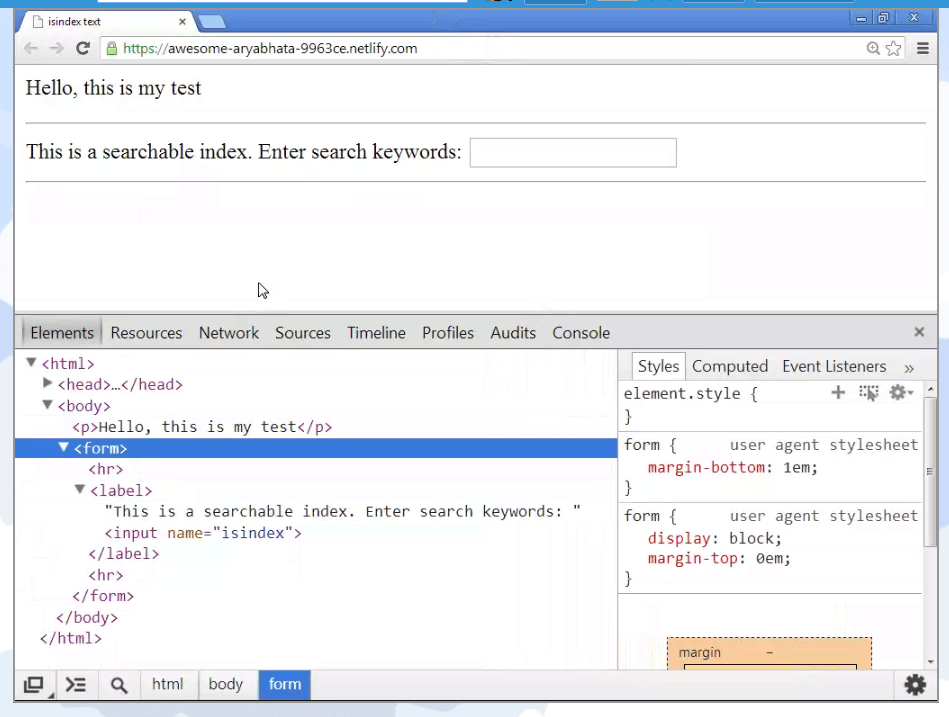
The rendered DOM in browsers resembled this - an injected form, two horizontal rules, label and an input:
Browser support
- Chrome 34: 2014-04-09
- Firefox 55: 2017-08-08
- Opera 21: 2014-05-06
- IE11: 2013-10-17
- Android Browser 4.4
- Lynx 2.8.8rel.2
To read
Drafts may be incomplete or entirely abandoned, so please forgive me. If you find an issue with a draft, or would like to see me write about something specifically, please try raising an issue.